


2026-11-02T08:13:27
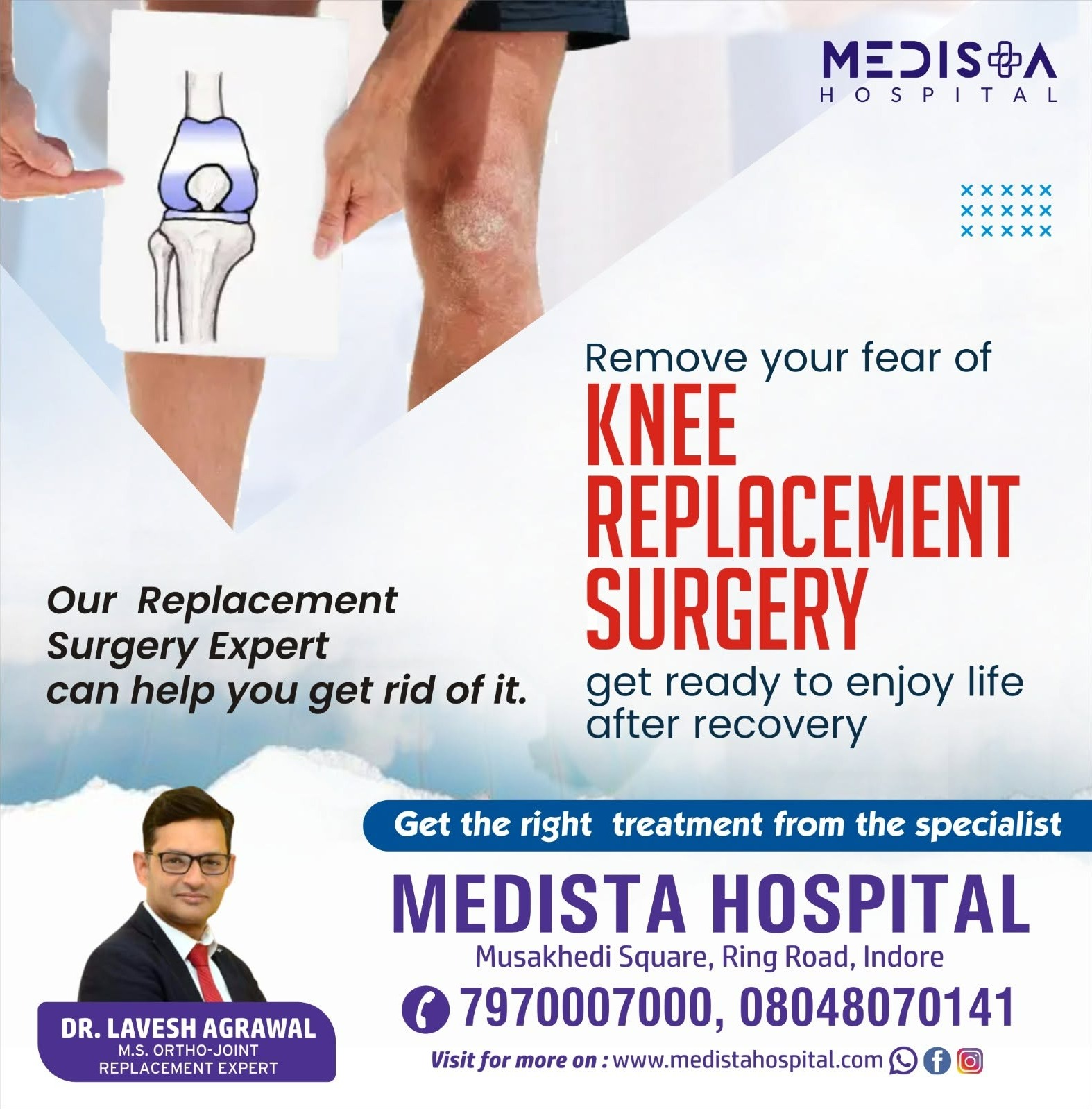
Knee Replacement Surgery in Dewas – Dr. Lavesh Agarwal at Medista Hospital Knee pain can significantly impact your daily activities, making even simple tasks like walking, climbing stairs, sitting, standing, and getting up from a chair difficult. Persistent knee pain, stiffness, swelling, and limited joint movement may indicate an underlying knee problem, requiring specialized orthopedic evaluation. When medications, physiotherapy, lifestyle changes, and other non-surgical treatments fail to provide relief, knee replacement surgery may be considered. If you are looking for knee replacement surgery in Dewas, Dr. Lavesh Agarwal at Medista Hospital provides orthopedic advice and guidance to those with severe knee pain, advanced knee arthritis, and other degenerative knee conditions. Knee replacement surgery, also known as knee arthroplasty, is a surgical procedure that replaces damaged joint surfaces with artificial components to reduce pain and improve joint function. The goal of this procedure is to help patients regain mobility, improve their ability to perform daily activities, and improve their overall quality of life. With a personalized treatment approach, accurate diagnosis, surgical planning, and rehabilitation guidance, patients can find the right treatment options based on their knee condition, age, activity level, and overall health. Meet Dr. Lavesh Agarwal, Orthopedic Surgeon at Medista Hospital Dr. Lavesh Agarwal is associated with orthopedic care at Medista Hospital, helping patients understand and manage various bone, joint, and musculoskeletal conditions. For those experiencing chronic knee pain, mobility issues, knee stiffness, or advanced osteoarthritis, consulting with an experienced orthopedic specialist is an essential step in identifying the right treatment. Dr. Lavesh Agarwal focuses on identifying the underlying cause of knee problems and discussing appropriate treatment options based on the patient's clinical condition. His approach to knee care includes: * A thorough evaluation of knee pain and joint movement. * Assessment for knee arthritis and cartilage damage. * Clinical examination and diagnostic investigation, if necessary. * Guidance on non-surgical and surgical treatment options. * Evaluation for partial or total knee replacement, where necessary. * Guidance on post-operative rehabilitation and recovery. Patients in Dewas and surrounding areas can seek orthopedic consultation at Medista Hospital for evaluation and treatment planning for persistent knee problems. What is Knee Replacement Surgery? Knee replacement surgery is an orthopedic procedure performed to treat severe damage to the knee joint, typically caused by osteoarthritis, rheumatoid arthritis, or serious knee injuries. The knee joint consists of the lower end of the thigh bone (femur), the upper end of the shin bone (tibia), and the kneecap (patella). These structures are covered with smooth cartilage that allows the joint to move smoothly. Over time, the cartilage can deteriorate or wear down. This can cause the bones to rub against each other, leading to pain, swelling, stiffness, and difficulty moving the knee. During knee replacement surgery, damaged joint surfaces are removed and replaced with artificial parts designed to facilitate joint movement. The main goals of knee replacement surgery are: * Relieve severe knee pain. * Improve joint movement and flexibility. * Correct some knee defects. * Improve walking ability. * Help patients perform daily activities. * Improve overall mobility and functional independence. The decision to undergo surgery depends on the severity of joint damage, symptoms, medical history, and the patient's overall health. When do you need knee replacement surgery? Not every patient with knee pain requires surgery. Many knee conditions can initially be managed with medication, physical therapy, exercise modifications, and other conservative treatments. However, when knee joint damage progresses and pain continues to interfere with daily activities, an orthopedic examination may be recommended for knee replacement. You may need to be evaluated for knee replacement if you experience these symptoms: 1. Persistent knee pain Persistent knee pain that doesn't respond to prescribed medications, physiotherapy, or other treatments may indicate significant joint damage. 2. Difficulty walking If knee pain, stiffness, or instability make even short distances difficult to walk, it's time to consult an orthopedic specialist. 3. Excessive Knee Stiffness Difficulty bending or straightening the knee can affect daily activities, such as sitting, standing, and getting in and out of vehicles. 4. Pain When Climbing Stairs Painful climbing or descending stairs is a common complaint among people with knee osteoarthritis. 5. Swelling and Inflammation Recurrent swelling, pain, and inflammation in the knee may be associated with arthritis or other joint diseases. 6. Knee Defects Advanced arthritis can sometimes cause changes in knee alignment, including a crooked leg or a crooked knee. 7. Sleep Disturbance Due to Knee Pain Excessive knee pain, even at rest or at night, can significantly impact sleep and quality of life. If these symptoms are affecting your daily activities, consult Dr. Lavesh Agarwal at Medista Hospital for a detailed orthopedic examination. Common Conditions That May Require Knee Replacement Surgery Many medical conditions can damage the knee joint and cause chronic pain and mobility issues. 1. Knee Osteoarthritis Osteoarthritis is one of the most common reasons for knee replacement surgery. It occurs when the protective cartilage covering the joint gradually wears down. This can cause pain, stiffness, swelling, and reduced joint movement. 2. Rheumatoid Arthritis Rheumatoid arthritis is an autoimmune condition that causes inflammation in the joints. Over time, persistent inflammation can damage cartilage and bone, affecting knee function. 3. Post-Traumatic Arthritis Previous knee injuries, fractures, or ligament damage can increase the risk of developing arthritis later in life. In severe cases, joint replacement may be considered. 4. Severe Cartilage Damage Severe cartilage damage can cause friction between joint surfaces, leading to persistent discomfort and restricted movement. 5. Advanced Degenerative Joint Disease Joint deterioration with age can gradually affect knee function. When damage becomes severe and conservative treatment is ineffective, replacement surgery may be an option. Types of Knee Replacement Surgery The type of knee replacement procedure depends on the extent of joint damage and its location. Dr. Lavesh Agarwal can assess the knee condition and discuss the appropriate surgical approach. 1. Total Knee Replacement Surgery Total knee replacement (TKR) involves replacing damaged surfaces of the knee joint with artificial implants. It is typically performed for patients with advanced arthritis affecting multiple parts of the knee. Potential benefits include: * Relief from severe arthritis-related pain. * Improved joint function. * Improved walking ability. * Improved daily activities. * Correction of some joint defects. 2. Partial Knee Replacement Surgery Partial knee replacement is performed when arthritis is limited to one part of the knee and the rest of the joint structure is intact. Unlike total knee replacement, this procedure preserves the natural knee joint function more fully. It may be appropriate for select patients after detailed clinical and radiological evaluation. 3. Bilateral Knee Replacement Bilateral knee replacement involves replacing both knee joints. It can be performed simultaneously or as separate procedures, depending on the patient's medical condition, fitness, and surgical assessment. This decision should be made after carefully weighing the risks and potential benefits. Benefits of Knee Replacement Surgery For patients with advanced knee arthritis, knee replacement surgery can significantly improve pain and mobility. Some potential benefits include: Reduced knee pain: Replacing damaged joint surfaces can significantly reduce arthritis-related pain. Improved mobility: Patients may experience improved ability to walk, stand, and perform daily activities. Improved joint function: The goal of this procedure is to improve knee movement and daily activities. Improved sleep: When severe knee pain is reduced, patients may experience better sleep and rest. Increased independence: Improved mobility can help patients perform many daily tasks with less assistance. Improved quality of life: Reduced pain and improved functional movement can help patients return to a more active lifestyle. Results vary from patient to patient, and surgery cannot guarantee completely pain-free movement or a normal, natural knee recovery. Why consult Dr. Lavesh Agarwal at Medista Hospital? Choosing the right orthopedic specialist is an essential part of managing serious knee problems. At Medista Hospital, Dr. Lavesh Agarwal provides orthopedic consultations to patients with knee pain, arthritis, joint stiffness, and mobility issues. Patients undergoing knee replacement surgery in Dewas can benefit from an evaluation that focuses on understanding the underlying problem and identifying appropriate treatment options. Key aspects of orthopedic care include: * Assessment of each individual knee joint. * Evaluation of arthritis and joint deterioration. * Discussion of available treatment options. * Guidance on appropriateness for surgery. * Assessment for total and partial knee replacement. * Guidance on post-operative recovery and rehabilitation. Medista Hospital is a 100-bed multispecialty hospital in Indore, providing healthcare services in various medical specialties. Patients in Dewas seeking specialized orthopedic advice may consider visiting Medista Hospital for further evaluation and treatment planning. Frequently Asked Questions (FAQs) – Knee Replacement Surgery in Dewas Q1. Who is the best doctor for knee replacement surgery in Dewas? Patients seeking knee replacement treatment in Dewas can consult Dr. Lavesh Agarwal at Medista Hospital for orthopedic evaluation and guidance. The right surgeon should be selected after considering his qualifications, surgical experience, treatment method, and the patient's medical needs. Q2. What is the right age for knee replacement surgery? There is no set age for knee replacement surgery. It depends on the severity of arthritis, joint damage, pain, mobility issues, and overall health. Surgery may be considered if non-surgical treatment does not provide adequate relief. Q3. How long does knee replacement surgery take? The time depends on the complexity of the procedure and whether one or both knees are being operated on. Your surgeon can provide an estimated recovery time after assessing your condition. Q4. Is knee replacement surgery painful? Pain and discomfort may occur after surgery, but proper anesthesia and post-operative pain management can help control this. Discomfort usually gradually subsides during recovery. Q5. How long does it take to walk after knee replacement surgery? Many patients begin standing and walking with assistance within the first day after surgery, depending on their medical condition and the surgeon's instructions. Q6. How long do knee replacement implants last? Modern knee replacement implants are designed for long-term use. Their lifespan depends on implant design, activity level, body weight, surgical factors, and other individual factors. Q7. Can I climb stairs after knee replacement surgery? Yes, many patients can gradually begin climbing stairs after surgery. The timing depends on muscle strength, flexibility, balance, and rehabilitation progress. Q8. Is physiotherapy necessary after knee replacement surgery? Yes. Physiotherapy is an important part of rehabilitation. It helps improve knee movement, muscle strength, balance, and walking ability. Q9. Can both knees be replaced at the same time? Some patients may have both knees replaced. However, this decision depends on overall health, surgical fitness, and the risks associated with simultaneous surgery. Q10. Is knee replacement surgery possible for elderly patients? Yes, elderly patients may be suitable candidates if their overall medical condition permits surgery. A detailed preoperative assessment is necessary. Knee Replacement Surgery in Dewas Best Knee Replacement Surgeon in Dewas Knee Replacement Doctor in Dewas Knee Replacement Hospital in Dewas Orthopedic Doctor for Knee Replacement in Dewas Total Knee Replacement in Dewas Knee Replacement Specialist in Dewas Knee Arthritis Treatment in Dewas Advanced Knee Pain Treatment in Dewas Total Knee Replacement Surgery Partial Knee Replacement Surgery Knee Joint Replacement Specialist Osteoarthritis Treatment in Dewas Knee Pain Doctor in Dewas Joint Replacement Surgeon in Dewas Knee Surgery Consultation in Dewas Orthopaedic Hospital Near Dewas Dr. Lavesh Agrawal Medista Hospital Knee Replacement Consultation in Indore